The problem
The hard part of an active tag is not the radio, it is the duty cycle. The tag has to sleep almost all the time, wake on a cheap timer, transmit for the few milliseconds the reader needs, and go back to sleep. The MCU sleep current has to sit below the cell's self discharge, or the firmware sets the battery life instead of the cell. The antenna also has to radiate at 866 MHz on the client's PCB. The European band sits a few percent below the 915 MHz default, which is enough for a copied footprint to walk off resonance and leave half the power in the feed.
What I did
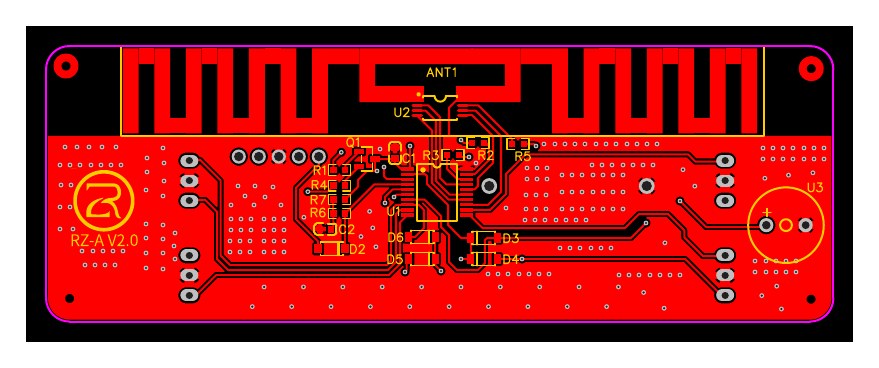
A PIC16F15243 runs the whole tag. It sits in its deepest sleep with a low power timer wake, wakes on the beacon interval, drives an AO3400A FET to turn on the RF rail, emits the beacon, drops the FET, kicks the buzzer if the schedule calls for it, and sleeps again. The dipole arm length came from the band centre wavelength scaled by the substrate's effective dielectric constant, the feed line tuned to the FET drain impedance, and the ground return stitched so the arms see a clean reference. The peripheral chain is a 3 V buzzer and an indicator LED on their own GPIO path, four JST connectors and an XH connector for service access, and a CR2032 holder on the back.
Decisions that shaped it
- A 20 pin PIC over a bigger MCU. The tag does not need pins, it needs deep sleep.
- A FET on the antenna feed rail, because leakage through the RF section 24 hours a day is what kills a coin cell.
- Dipole sized for 866 MHz on the real substrate, not a 915 MHz reference.
- Feedback LED and buzzer on a separate path so they never modulate the radio rail.
Result
Sub microamp sleep, a dipole that radiates where the reader listens, and a BOM small enough to quote from LCSC.