The problem
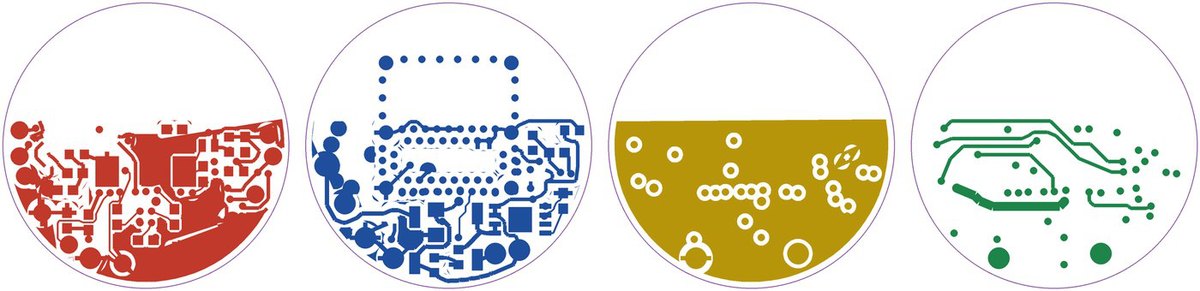
The case is 16 to 19 mm, so every part is judged by its diagonal. The radio had to be a pre certified module so the client never pays for radio certification, and small, certified and cheap rarely coexist. Standby had to be months on 45 mAh with a vibration motor that turned out to draw 410 mA at start up. The case has a gold ring that is near resonant at 2.4 GHz, and IPX6 sealing means magnetic charge contacts instead of a port.
What I did
Thirteen modules were screened against hard gates before any scoring: diagonal under 9.5 mm, certification actually granted, an obtainable SDK, sleep under 3 uA, hardware debug, and supply at 1, 500 and 5,000 pieces. The finalist was the Insight SiP ISP2454-LX on a Nordic nRF54L15, certified for CE, FCC, IC, TELEC and Bluetooth SIG. Every power figure was a PPK2 measurement. That found a 23 uA floor hiding under every early reading: one line of button setup using an edge triggered interrupt held a clock alive. Level triggered wake took idle from 26.5 to 3.47 uA.
The motor is driven through a 600 mA FET with the return path off the module ground and a PWM ramp in firmware. A 25 nA LDO regulates to 3.0 V. The battery divider is FET switched because 1.5 uA of leak was 40 percent of the budget. Placing an 8 mm module, a click dome, an LED, two contacts, four wire pads and ten test pads on a 16 mm disc did not close by hand, so I wrote a small placement search with real courtyards and a collision test. Then I checked the exported Gerbers with my own script.
It found a plane that did not reach the rim and a stray outline object that crossed the charge input hole on the ground layer and would have shorted the charger on every board. The EDA tool's design rule check had passed with zero errors.
Decisions that shaped it
- Certainty over two millimetres. The client chose the certified 8 mm module over an uncertified 6 mm one with no SDK.
- Measured beats claimed. Every number in the design came from the bench.
- A removable 0 ohm antenna link reached through vias, so a ring that detunes the antenna can be answered without a new board.
- Verify the fabrication files independently before spending money.
Result
3.47 uA idle, 10.7 uA advertising at 1 s, 100 to 180 days on 45 mAh. Prototype batch ordered.